


Getting enough protein in your daily diet is vital for your long-term health. And with all the specialist products on the shelves at the moment, it can be easy to assume that these protein supplements are the best way to pack it in. In fact, our busy lives often demand it – grab-and-go solutions are convenient for time-poor mornings or a mindless quick fix. But are powders really the most convenient option, or have we just fallen for a marketing ploy? We’re here to end the whole protein powder vs food debate once and for all, discovering which, actually, is the best option for you.
Let’s get into it:

What do we mean by ‘convenience’?
To keep the fight fair, let’s clarify what we mean by a convenient option. We’re taking into account five main factors in the convenience battle:
- Time it takes to prep and consume
- How accessible is is, anywhere, anytime
- How much effort goes into planning, cooking and cleaning
- How easy it is to stay consistent daily
- The upfront and long-term cost
So, while speed is important, it’s not all convenience is about. For us, the most convenient option is the one that fits into your routine in the most seamless way possible. So with this in mind, let’s introduce contestant number one.
The case for real food
As a species, whole food protein has always been a part of our diet. Many people hold this type of protein supreme, maintaining that it’s always the best option when trying to hit our protein goals. But how does it actually hold up under our scrutiny?
The pros of whole food protein
Real food proteins have some real good perks. These include:
- Nutrient density: high quality whole foods are full of protein and vitamins, minerals, fibre, and healthy fats that our bodies need to function
- High satiety: whole foods keep you fuller for longer compared to liquids, helping you manage calories and keep energised throughout the day
- Social and community perks: it’s more social, satisfying and (arguably) enjoyable to tuck into a whole food feast
- Cleaner eating: while there are some great healthy protein shakes out there, whole foods allow you to avoid processed ingredients more easily
The cons of whole food protein
These pros are all well and good, but there are some ways whole foods let themselves down in the convenience race:
- Higher time cost: shopping, prep, cooking and cleanup can all add up bit by bit
- The need to plan: whole foods mean you need to think ahead to hit your protein targets for the week
- Less portability: it can be harder to carry whole food snacks and meals around, especially if they need refrigerating
- Less consistency: it can be easy to under-eat protein on busy days if you’re relying on protein-packed whole food recipes
The case for protein powder
It’s varied, it’s everywhere, it’s social media’s favourite recommendation, but how does protein powder compare to good old-fashioned food?
The pros of protein powder
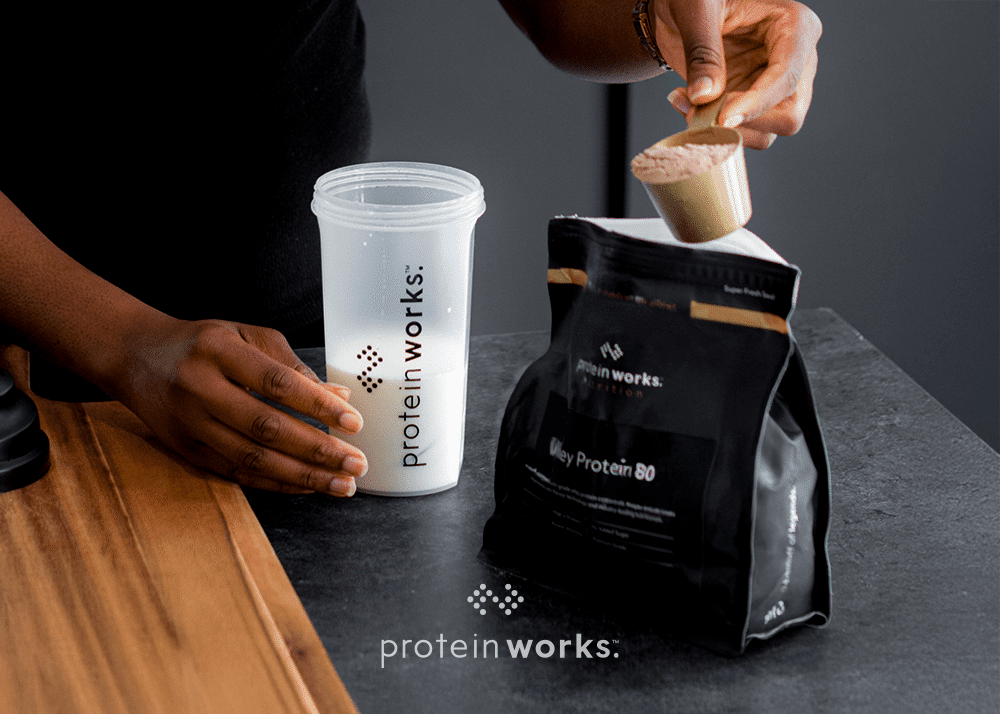
With its grab-and-go properties, the case for convenience when it comes to protein powder is strong. Here’s how it stands out:
- Fast: takes less than 30 seconds to prepare (and less if it’s pre-bottled)
- Low effort: there’s no cooking, no planning, and very little cleanup
- More portability: it’s designed to be easy to carry and very travel-friendly
- Consistent: get the same amount of protein, every single time
- Low cost per serving: it’s often cheaper per gram of protein than many whole foods
- Less food waste: protein powder has a long shelf life in comparison to fresh food
The cons of protein powder
Sounds good, but it’s not all sunshine and rainbows. Here’s how protein powder falls short:
- Lower satiety: your body can digest liquids faster than solids, so can get hungry faster (depending on the formulation)
- Less nutrient diversity: protein powder is typically exactly as it sounds – pure protein. However, Protein Works’ Whey & Vegan 360 range is formulated with vitamins and minerals too!
- Not a full meal replacement: supplements lack the balance of whole foods that we need to stay healthy
- Risk of over-reliance: it’s easy to slip into the habit of always reaching for protein powder
So, which one is more convenient?
The results are in… kind of. Deciding whether to prioritise whole foods or protein powders depends heavily on your schedule. Of course, grabbing a quick shake will always be the fastest, most efficient way to reach your protein goals. And in contrast, whole foods take more active time out of your day, requiring preparation, cooking, cleaning and plenty of planning.
However, solely relying on protein powder as a source of this vital nutrient is not best for a healthy, balanced diet, no matter how many grams you’re getting. Instead, we’re reframing the debate from ‘protein powder vs. food’, to ‘protein powder and food’.
Most people are extremely busy, and struggle to fit three well-rounded, whole meals into their day – including us. So, the convenience of protein powders comes in clutch when filling the gaps in your whole food intake, not replacing it.
When to reach for powders over food
For your mail meals, social eating, and days where you have the time to whip something up, always prioritise whole foods. It’s more nutritionally rounded, that bit more satiating, and is what our bodies are designed to consume.
That said, there are times when protein powders make more sense (especially if it’s the difference between eating something and nothing at all):
- Busy mornings
- When travelling
- When your appetite is low
The key: find a good balance
We know, we know: the big ‘protein powder vs. food’ fight hasn’t ended in a sweeping victory for either player. But as always when it comes to diet and wellness, the real winner is ‘everything in moderation’.
In truth, the most convenient option for you is entirely personal. Schedule, budget constraints, personal goals: all will have an impact on your individual pick. When it comes to getting more bang (protein) for your buck (mouthful), protein powder often comes out on top. But convenience can never replace the health benefits of good quality, whole foods.
It’s vital to remember that, whatever your goals or restraints, protein powders will always be a solution and not a necessity. If you ask us, the most convenient option is the one you’ll actually stick to and enjoy, and a routine full of quick protein powder breaks is simply not one we could – or should – keep up.
So, while protein powders might be the most convenient on paper, the best results for your body come from combining them with tasty whole foods that you love. And when you can’t fit that in, supplement it with a protein shake that tastes just as good.
Shop our range of top-quality protein powders, or quick and delicious high-protein foods.




No Comments yet!