
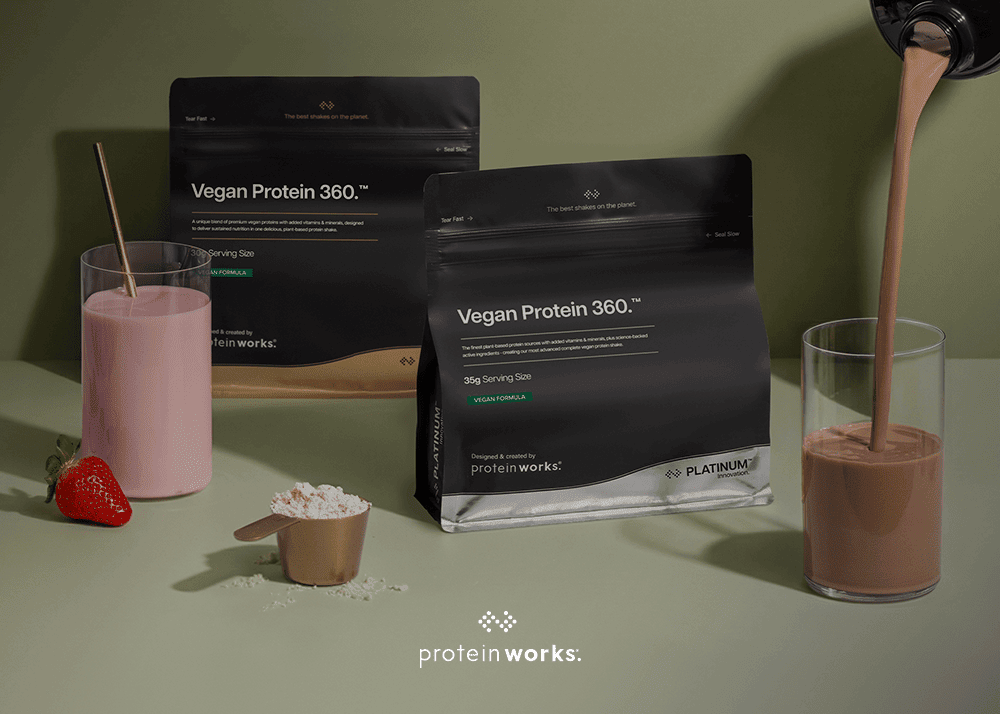

The vegan protein powder market has grown significantly – but so has the number of products cutting corners on amino acid completeness, digestibility, and taste. This guide cuts through that. What plant protein is, why it is harder to get right than dairy protein, what to look for on the label, what to avoid, and how we at Protein Works approach each of these questions. Here is the short answer before we get into the detail: the quality of a vegan protein powder comes down to four things – the completeness of its amino acid profile, how well the body can actually absorb it, whether it tastes good enough to use consistently, and how well it fits into your daily nutrition. So what is the best vegan protein powder in 2026? Let’s break all of it down.

Why Plant Protein is Harder to Get Right
To understand what makes a vegan protein powder good, you need to understand amino acids – specifically which ones are essential and why plant sources vary in how well they deliver them.
Nine amino acids are classified as essential. That means the body cannot make them and must obtain them through diet. A protein source that contains all nine in sufficient amounts is called a ‘complete’ protein. Whey delivers this naturally. However, most individual plant proteins do not, and understanding why is the key to reading a vegan protein label correctly.
Here is how the most common plant sources compare. Pea protein is high in arginine and branched-chain amino acids, but is lower in methionine. Rice protein is lower in lysine; it is typically derived from whole grain brown rice, and the source of the rice and the extraction method both affect the final amino acid profile – which is why the grade of rice protein used matters, not just its presence on an ingredients label. Hemp protein contains all nine essential amino acids, but in lower concentrations overall, making it more effective as a contributor to a blend than as a standalone source. Pumpkin seed protein offers a broader amino acid profile and is notably higher in certain microminerals, including zinc and magnesium.
Soy protein is the exception among plant sources. It is the only common plant protein that scores 1.0 on the PDCAAS – the standard measure of protein quality – matching whey protein. It delivers a complete amino acid profile and is highly bioavailable, but has a narrower application due to allergen considerations.
The Blending Solution
When you combine pea and rice protein, the lysine from pea compensates for what rice lacks, and the methionine from rice compensates for what pea lacks. The result is a complementary amino acid profile meaningfully closer to a complete pattern. Add hemp and pumpkin seed, and the profile becomes more complete still. This is why the number of protein sources in a vegan product is a genuine quality indicator, not just a marketing point.
Why Protein Intake Matters & Why it’s Harder on a Plant-based Diet.
Protein is one of the three core macronutrients – alongside carbohydrates and fats – and it is involved in virtually every structural process in the body. The UK Reference Nutrient Intake (RNI) for protein, set by the Committee on Medical Aspects of Food Policy (COMA) and upheld by the Scientific Advisory Committee on Nutrition (SACN), is 0.75g of protein per kilogram of bodyweight per day for adults. [1]
In practice, many people benefit from more than this. Research suggests a meaningful daily target can range from 1.2g to 1.6g of protein per kilogram of bodyweight depending on age and lifestyle. [2] For someone weighing 70kg, that means 84 – 112g of protein per day – a target that is genuinely difficult to hit on a plant-based diet without being deliberate about it.
This is compounded by a second factor: protein becomes more important as we get older. From our mid-30s onwards, the body becomes less efficient at using dietary protein – a process called anabolic resistance. The bar for adequate intake rises with age, and the quality of the protein you consume matters more, not less. For anyone following a plant-based diet and in their 30s or beyond, both the quantity and completeness of daily protein deserves real attention.
Digestibility and Absorption
Even a nutritionally complete plant protein blend has to be absorbed effectively to deliver its value. Plant proteins are generally harder for the body to process than whey. The PDCAAS scores whey at 1.0: the maximum. Pea protein sits around 0.89. Blending protein sources and supporting digestion with enzymes closes this gap significantly.
Digezyme® is a multi-enzyme complex used in the GOLD and PLATINUM tiers of the Vegan Protein 360 range. It supports the breakdown of key macronutrients including protein and aids their absorption by the body. Protease enzymes specifically break down protein peptide bonds, improving the release and availability of amino acids post-digestion.
Vegan Protein 360 – PLATINUM includes probiotics at 10.5 million CFU per serving, designed to promote a healthy gut microbiome and support digestive comfort. A well-functioning gut microbiome improves nutrient absorption across the board, compounding the impact of the protein and micronutrient content of the shake.
One further note on gut health: whole food plant sources naturally carry fibre, which acts as a prebiotic – feeding the beneficial bacteria in the gut. When protein is concentrated and isolated from plant sources, some of that fibre is removed in the process. Pairing a vegan protein supplement with fibre-rich whole foods supports the gut environment that makes the supplement itself more effective.
What to Look For on the Label
When evaluating a vegan protein powder, here are the things that actually matter – and what to look for in each.
Number of protein sources. One plant source is a starting point. Two creates a more complementary profile. Three improves it further. Four – pea, rice, hemp, and pumpkin seed – is the most complete approach currently available in the Protein Works range.
Protein per serving. Vegan Protein 360 – BLACK delivers 20g at 92 calories. Moving along the tiers, Vegan Protein 360 – GOLD delivers 25g at 110 calories while Vegan Protein 360 – PLATINUM delivers 29g at 125 calories. What’s more, all three contain no added sugar.
Vitamins and minerals. Vegan Protein 360 – BLACK is a clean, pure protein with no added vitamins or minerals – the benchmark for transparent, unfussy plant protein. In contrast, Vegan Protein 360 – GOLD contains 12 vitamins and minerals, unlocking 87 EU-approved science-backed health benefits. Vegan Protein 360 – PLATINUM is our most advanced formula, with 26 vitamins and minerals delivering 166 EU-approved health benefits, electrolytes (sodium, potassium, and magnesium, all at 15%+ NRV), and Omega 3, which contributes to the maintenance of normal blood cholesterol levels. [3]
Digestive enzyme support. Look for Digezyme® or a comparable enzyme complex. This directly affects how much of the protein you consume you actually absorb – particularly relevant for plant protein, which is inherently harder to process than whey.
Taste and texture. Historically the defining failure mode of plant protein products. Chalky or gritty texture is a formulation problem, not an inherent limitation of plant protein – it reflects a lack of investment in ingredient quality and processing. Here at Protein Works, every flavour is developed in-house. Across the range, the products are versatile enough for shakes, smoothies, and baking.
What to Avoid
No blending of sources. A single plant protein source – pea on its own, for example – is a perfectly good ingredient that works well in things like baking and when combined with other protein sources in your wider diet. But as the sole protein source in a shake designed to boost your plant protein intake, it will have gaps in its amino acid profile that a well-designed blend compensates for directly in the formulation.
Excessive sweetness masking poor formulation. Sweeteners are a normal part of protein powder formulation and make daily use more enjoyable without adding sugar. The issue is when a product relies on excessive sweetness to mask poor ingredient quality or a weak flavour base. A good formulation solves taste at the ingredient and processing level, with sweeteners used to complement rather than cover.
Poor texture and mixability. A product that mixes badly or leaves a gritty residue is one that daily use will make very apparent. Inconsistency is where the value disappears. Texture problems in plant protein are solvable – they just require investment.
Nothing beyond protein. If a vegan protein offers nothing beyond its protein content, it is a missed opportunity. Products at GOLD and PLATINUM tier specifically address the broader nutritional gaps that come with any diet – vitamins, minerals, digestive support, and electrolytes. Whether that level of formulation is right for you depends on what else your diet covers. That being said, for those new to protein powders, a more streamlined formulation is a perfectly fine entry point.
How Protein Works Approaches Vegan Protein
The Protein Works vegan range is built on the same 360 concept as the dairy range, Whey Protein 360 : nutritional content, ingredient quality, product efficacy, and taste and texture – considered together, not traded off against each other. Every product is formulated in the UK.
Vegan Protein 360 BLACK is our a dual-sourced blend delivering 20g protein, all nine essential amino acids, no added sugar, at 92 calories per serving. Five flavours. The entry point for anyone who wants a clean, transparent, premium plant protein without added complexity.
Vegan Protein 360 GOLD is a tri-sourced, nutrient-dense blend with 25g protein, 12 vitamins and minerals, Digezyme® for digestive support, and 87 EU-approved health benefits per serving. 110 calories. Eight flavours including Premium options.
Vegan Protein 360 PLATINUM is a quad-blend including premium pumpkin seed protein, delivering 29g protein, 26 vitamins and minerals, Digezyme®, 10.5 million CFU probiotics, Omega 3 – which contributes to the maintenance of normal blood cholesterol levels – and 166 EU-approved health benefits. 125 calories. Twelve flavours including Premium options. The most nutritionally complete plant protein in the range.
Every product is formulated in the UK. Every flavour is developed in-house. The same standard – outstanding nutritional content, ingredient quality, efficacy, and taste – applies across all three tiers.
That is everything you need to know to choose the best vegan protein powder in 2026. Got questions? Reach out to us on Instagram, TikTok, or Facebook.
Browse the full Protein Works Vegan Range.


References
- UK Reference Nutrient Intake (RNI) for Protein. Committee on Medical Aspects of Food Policy (COMA). Dietary Reference Values for Food Energy and Nutrients for the United Kingdom. Department of Health Report on Health and Social Subjects No. 41. London: HMSO, 1991. Upheld and maintained by the Scientific Advisory Committee on Nutrition (SACN). nutrition.org.uk — Protein: Reference Nutrient Intake
- Protein intake ranges for adults. Morton RW, Murphy KT, McKellar SR, et al. A systematic review, meta-analysis and meta-regression of the effect of protein supplementation on resistance training-induced gains in muscle mass and strength in healthy adults. British Journal of Sports Medicine. 2018;52(6):376–384. American Journal of Clinical Nutrition joint advisory, May 2025.
- Omega 3 and normal blood cholesterol levels. EU-approved health claim under Regulation (EC) No 1924/2006.


No Comments yet!